







The setter represents the cornerstone on which a team's offensive system is based, a crucial sector for performance.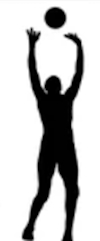
It is the connecting role between the reception (or defence) and the execution of the attack. In the receiving phase, statistics indicate that between 92% and 97% of balls are touched by the setter, whereas in the serving phase, the percentage ranges from 46% to 61%.
His initial position in the formation during receiving determines the so-called "phase" (numbered from 1 to 6, or P1, P2, etc.), from which the position of the other athletes and the possible game schemes to be implemented derive.
He must be a leader, not only on the field, but also off it.
He must possess a wealth of coordination skills that must be as broad as possible, based on which a high level of specific dribbling technique can be inserted.
He is certainly the player who cooperates most with the coach and shares his plans and strategies.
Even if, at a high level, there is an increasing tendency towards a simplification and standardisation of tactical choices, the difficulty in the construction of the setter's game lies in the management of the various types of sets to be made.
A setter must combine the variety of trajectories, their precision, adapt their speed and their height to each of the attackers, and remain as unpredictable as possible for the opposing blockers.
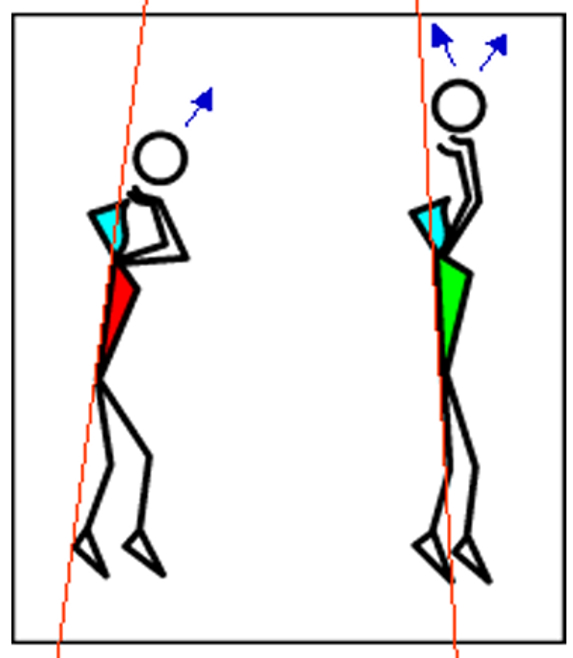
The search for a neutral position under the ball for all types of sets makes it more difficult for the opposing blocker to read the tactical choices.
At the high level, the setter makes almost all of his sets in suspension. This depends on both a tactical need, because the attacking game becomes faster, and a technical need, since in the elevated dribbling it is easy to maintain the neutral position of the body.
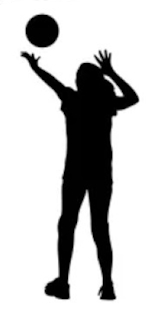
Serve in volleyball is the action that starts the game, in each set.
The player stands behind the baseline and hits the ball to reach the opponent's court in a single movement.
The goal is obviously to score a point, landing it within the valid perimeter. The serve point phase can be considered as the maximum expression of the individual player, because it is performed in full autonomy. In fact, in a set, in no other phase of the game does the player have complete control of the action as in the service.
It therefore requires a lot of skill in setting the direction and speed of the ball, so as to make it difficult for the opposing receiver to intercept it correctly in reception. Although in match situations the server does not communicate before the service, the coach can signal him to serve in a specific area. The service strategy often aims at the opponent's weaker receiver or the space (conflict zone) between two players. Therefore, serving with good ball control and direction is important.
The service is called "ace" when it scores the point, that is, if the ball falls directly into the opponent's court, or goes out after being touched by an opponent. This type of serve is therefore a winning serve, because it allows you to score a point automatically, without any reaction from the opponent.
In the youth categories, Under 12 and 13, the so-called "underhand serve" is used, in which the player hits the ball from below, not from above. Serves of this type are easier to learn: however, it is a more predictable serve than others, because it is parabolic, therefore much slower, it is considered very easy to receive and is rarely used in high-level competitions.
The overhead serve, on the other hand, is nowadays characterised by greater instability and unpredictability, which obviously makes it more insidious for opposing players in reception.
Until the first half of the 1990s, the service could only be performed from three meters to the right of the baseline (behind position 1, to be clear), but starting from 1995 it is allowed to serve along the entire 9-meter line (also behind position 6 and position 5), thus increasing the type of possible directions.
The following types of serve can be distinguished in volleyball:
The two favourite types of serve in volleyball are the jump float and the jump spin, but which one should you use?
If the disadvantage of the jump float is that it generates fewer aces than other serve techniques, since it is slower, performing a jump spin is always a risk, because – if not performed with enough power – it could be ineffective and easily predictable by the opposing team.
In addition, the jump spin serve requires a good amount of coordination and the ability to throw the ball which requires a lot of training. Each player and each team must evaluate how to move depending on the situation on the court and the technique they want to implement.
When you have to decide what type of serve to make, you have to evaluate whether to use a tactical serve or a strong one, depending on the objective you want to achieve:
An effective server must therefore develop both a powerful serve and the ability to serve in a specific area..
Playing ball was considered a pleasant pastime in ancient Greece and the Roman Empire, a tradition that continued into the Middle Ages.
During that period, a game similar to modern volleyball quickly spread. It survived for centuries and was later renamed Faustball (literally, “fistball ") in 19th-century Germany.
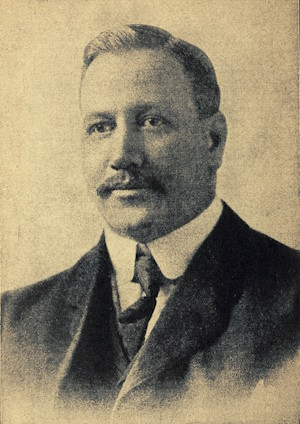 William G Morgan
On February 9, 1895, William Morgan, a physical education teacher from Massachusetts, invented a new sport, which he renamed minonette: this was the forerunner of modern volleyball. It can therefore be said that volleyball was born in the USA at the end of the 19th century, but at the time it was still a slightly different sport than the one played today.
William Morgan's goal at the time was to invent a game that would become as popular as basketball. The practical demonstration of how to play minonette (a term that derives from the French "minon", literally "cat", an ancient ball game popular among the French nobility) took place in a college in Springfield on February 9, 1895.
The event was not only an opportunity to present a new game but also to shine a spotlight on a revolutionary aspect related to the way of playing.
Compared to the most popular sports of the time, in fact, minonette did not rely on physical strength to prevail over opponents, but on other skills, such as agility, speed of movement, quick reflexes and the ability to concentrate.
Minonette had simple rules: the ball had to be touched with the hands, for an unlimited number of times, and the match was played in sets.
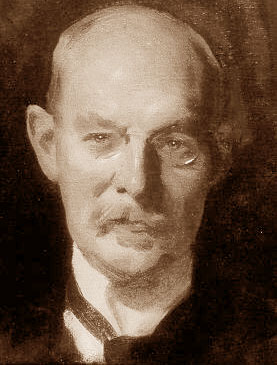 Alfred H Halstead
In the evolution of the history of volleyball, an important contribution was made by Alfred H. Halstead, another American physical education teacher, who changed the name of minonette to volleyball on March 10, 1896. It was also thanks to Halstead's tireless work that volleyball spread widely in the USA and, from there, to the rest of the world.
From the United States, where it did not have an easy start at the beginning, volleyball began to be played with passion in South America, particularly in Brazil, Argentina and Uruguay. From here it began to spread towards Asia: in 1898 volleyball arrived in Manila, in the Philippines, which was the scene of the first spikes, and from there it continued its unstoppable run towards China (in 1906, brought by YMCA teachers Max Exner and Howard Crockner) and Japan (1908), where it achieved incredible success.
At the beginning, the way of playing depending on the place differed in some aspects: the ways of playing were different (Western and Eastern).
In 1912, the rule that provides for the clockwise rotation of the athletes was introduced.
Volleyball arrived in Europe during the First World War, imported by American troops. Dr. George J. Fisher, secretary of the YMCA War work, included it in the recreational programs of the US Army, to which Spalding & Brothers made available 16,000 balls. England was the first European country to adopt volleyball (1914).
Volleyball also arrived in Italy with the American army. In Porto Corsini, the port of Ravenna, in 1917-18 the US soldiers of the local seaplane base regularly practiced this sport.
1916 George J. Fisher publishes the new rules of the game in Spalding's Athletic Library, issue 364, cost 10 cents:
In 1922, the rule of three maximum touches allowed for each team to return the ball to the opposite field was introduced. The first YMCA championship of the USA and Canada was organized, as a technical demonstration for the subsequent Olympic Games in 1924.
Then the discipline began to standardize, especially after 1938 – the date in which the “block” technique was imposed: from that moment on, the discipline quickly standardized.
The Italian Volleyball Federation (FIPAV) was born in 1946 when volleyball began to spread especially among the youngest.
In 1947, representatives of 15 federations met in Paris and created the Fédération Internationale de Volleyball (FIVB).
Volleyball still has a large following today, especially in the Far East (Japan, China, South Korea), in Eastern and Southern European countries, and in Brazil.
These countries can also boast the best international results both at the club and national team level. Countries such as Brazil, Italy, the United States of America, Russia, Serbia and Cuba have their national teams at the top of the rankings for both men and women; other countries can only boast one national team (male or female) at the top of the rankings (Japan and China for women, Argentina for men).
Many other countries remain on the sidelines and, except for rare cases, it is always the same countries that compete for the laurels of the most important tournaments.
Over time, several changes to the regulations have occurred (from the integral rally point system starting in 2000 to the libero starting in 1997, from disciplinary measures to field lines) up to the current international regulation.
The volleyball court is 18 meters from endline to endline and 9 meters from sideline to sideline.
 volleyball court
The centerline (below the net) divides the court in half. Each team’s attack line is three meters from the centerline. A back-row player must stay behind the attack line when jumping to contact a ball that is above the height of the net. Players may initiate the serve from anywhere along the endline.
For women’s volleyball, the net is 2.24 meters (7 feet, 4-1/8 inches) high; for men’s volleyball, the net is 2.43 meters (7 feet, 11-5/8inches) high. The net should be strung tightly to avoid any sagging and to allow a ball driven into the net to rebound cleanly instead of dropping straight to the floor.
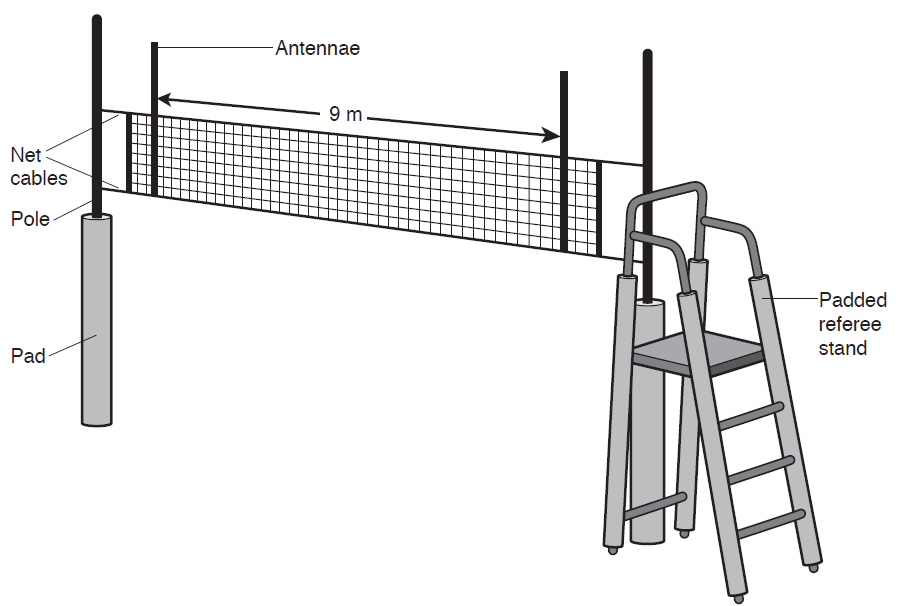 Volleyball net
Antennae are connected to the volleyball net just above the sidelines. The volleyball must always pass over the net and between the antennae on a serve and throughout a rally. Safety rules require that the poles and the referee stand must be padded.
Volleyball is a sport played by two teams on a playing court divided by a net. There are different versions of the game, which can be adapted to specific circumstances, to ensure that everyone can enjoy the versatility of the game.
The game aims to send the ball over the net to land on the opposing team's court and prevent this from happening on their own court. The team has three hits to return the ball (in addition to the blocked hit).
The ball is put into play with a service: sent with a hit by the server over the net towards the opponents. The action continues until the ball touches the court, is sent out, or a team fails to return it correctly.
In volleyball, the team that wins a rally scores a point. When the receiving team wins a rally, it scores a point and the right to serve, and its players rotate one position clockwise.
The concept of rotation ensures that all athletes are complete. The rules on the positions of the athletes must allow the teams to be flexible and to create interesting tactical developments.
The competitors use this structure to develop techniques, tactics and power of play and this allows the players a freedom of expression that excites spectators and viewers.
Italian sites:
Page 3 of 4
Select your language


For information, contact us (only by appointment).
Send an e-mail to:
info@studio-martorelli.eu