







Below are links to the training materials presented to my athletes during training.
 (Setting) (Setting in volleyball) (The setter) (Suspension setting after control setting)
Below are links to the training materials presented to my athletes during training.
Blocking is the main defensive action of players at the net to stop or alter an opponent's attack.
Blocking can also be offensive, aiming to completely stop the attack and keep the ball in the opponent's court.
A well-executed offensive block involves jumping and stretching to go over the net with the arms, sticking them out into the opponent's area. It therefore requires anticipating the direction of the ball in attack.
Blocking is part of the fundamentals of the phases of:
The block is classified according to the number of players involved. It can therefore be called a single, double or triple block.
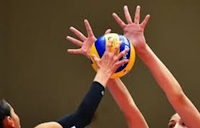 Single block Single block |
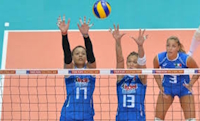 Double block Double block |
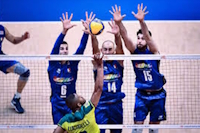 Muro triplo Muro triplo |
The block is a fundamental that does not present particular technical differentiation, but the needs of the game indicate functional situational adaptation strategies used by the players
The block is not always effective. Furthermore, it is sometimes circumvented with attack systems other than the spike (e.g. lob!).
However, a block that forces the attacker to use different strategies is still very useful.
The position of the block influences the positions in which the other defenders are placed, while the opposing servers spike.
Let's start with what we can define as the fundamental objectives of the block; namely:
These points will reach the greatest effectiveness, the better the execution technique. To be able to perform an effective blocking action, it is not essential to be very tall or jump a lot; that is, it is not the height of the wall that determines its success, but a set of other qualities that involve:
In particular, the evaluation of the most appropriate jump time will be related to the type of construction chosen by the opponent and will determine the precise times of the translocations and jumps!
will be related to the "space" that the wall will have to take.
The six players on a volleyball team have the duty, during the match, to rotate clockwise when their team is receiving and scores while the opponents are serving. Learning to rotate positions is, therefore, fundamental.
The roles in volleyball can be divided into two main fronts: attack and defence. The attack roles are played on the front line, that is, those players who play under the net.
During a volleyball match, there are six players but there is one, called the “libero”, who enters the court when the player occupying the central positions is on the second defence line.
The roles of the players on the court are five:
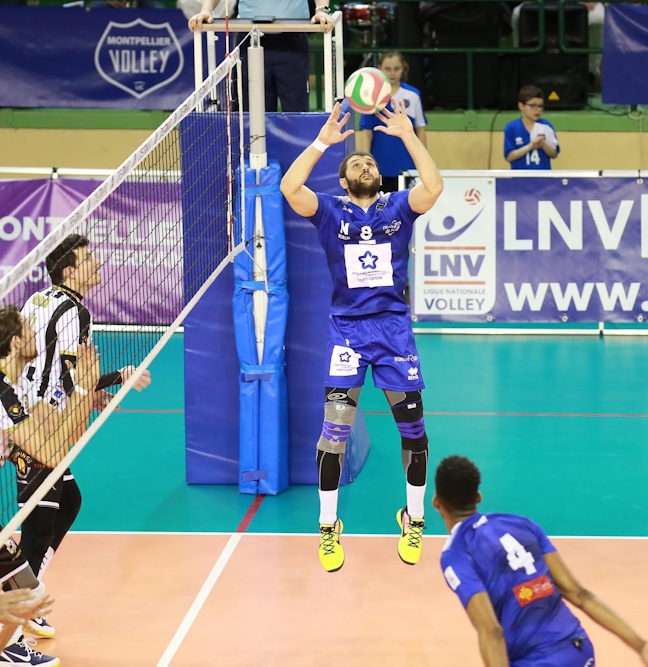 Setter Saitta in actionBoth on high and distant sets and on close and fast sets, the accuracy of the setting is fundamental.
This is certainly the most typical characteristic of the setter, who must put his teammates in a position to spike positively. The regular performance of a spiker is, in fact, largely the result of constant accuracy in the settings he receives.
Furthermore, with equal accuracy of the set, what makes the difference between one setter and another is the choice of the type of setting, which can substantially influence the performance of the individual attackers and, consequently, of the entire team. In this case, we speak of tactical intelligence.
Every set requires great clarity to make the most of both the attacking potential of your hitters and the defensive weaknesses of your opponent.
Reactivity in movement is also essential: it is necessary because the setter is rarely already at the starting point of the court where he will perform the second touch and is often forced, instead, to cover several meters of running to get into the correct position on the ball. A setter with modest reaction times will frequently be late and therefore, finding himself out of balance, will hardly be able to set decent balls to his attackers.
A soft and natural touch of the ball is also very important. There are essentially two types of setters: those who have a natural touch of dribbling and those who have built it up over the years with training.
The substantial difference between these two categories is that the former has less difficulty in dealing with particularly stressful situations, while the latter, in positions of poor balance or conditions of high physical and psychological tension, tend to "dirty" the dribbling, which can also become imprecise and foul-prone (double fault).
The height of the players has become of determining importance (or if the player is short, he must have good elevation), especially to be able to block the opponent's attacks. Even the setters have felt the effects of this trend, taking into account, then, the fact that the setter, when he is on the front line, will have to block the attack of the side hitter of the opposing team.
Page 2 of 4
Select your language

For information, contact us (only by appointment).
Send an e-mail to:
info@studio-martorelli.eu